
Every executive in payments and software has heard "embedded finance" — but what it means in practice, and what it takes to actually launch it, is less clear. This post covers the definition, why the business case is compelling, and where most platforms stand today.
Here's the definition we use at Jaris, and how Jane Podbelskaya, Founder of Charge Forward, opened our recent PayTech Women webinar:
Embedded finance is financial services delivered inside a non-bank product, at the moment of need — without the customer leaving the platform they already use.
Simple. But it carries more weight than it looks like.
Who this applies to
There are two distinct audiences building embedded finance businesses today, and the strategic question — how do I move from single-product to multi-product? — is the same for both.
Software platforms — vertical SaaS companies, marketplaces, and AI-native operators that embed financial products into the workflows their merchants already depend on. Think Toast, Shopify, ServiceTitan, AppFolio, HoneyBook, and TouchBistro.
Payment platforms and ISOs — companies that started in payment processing and are now expanding to deliver lending, instant payouts, and banking services to the merchants they already serve. For this group, the embedded finance conversation has shifted significantly in the last 24 months: ISOs are now competing on product depth, not pricing. The platforms and processors that are holding their merchant portfolios are the ones that partnered or built financial products. Those that haven't are seeing increasing churn.
At Jaris, we work with both audiences — and the underlying dynamics are the same. Software has become a dominant SMB distribution channel and excels at winning and retaining the merchant relationship. If you're a payments company or ISO, your path to relevance runs through the integrated software layer. The numbers bear this out: 69% of US SMBs — a share approaching 86% — already get payment acceptance from their software providers rather than from banks or processors, and platforms’ share of US merchant acquiring has grown from 33% to 45%.
Categories of embedded financial products
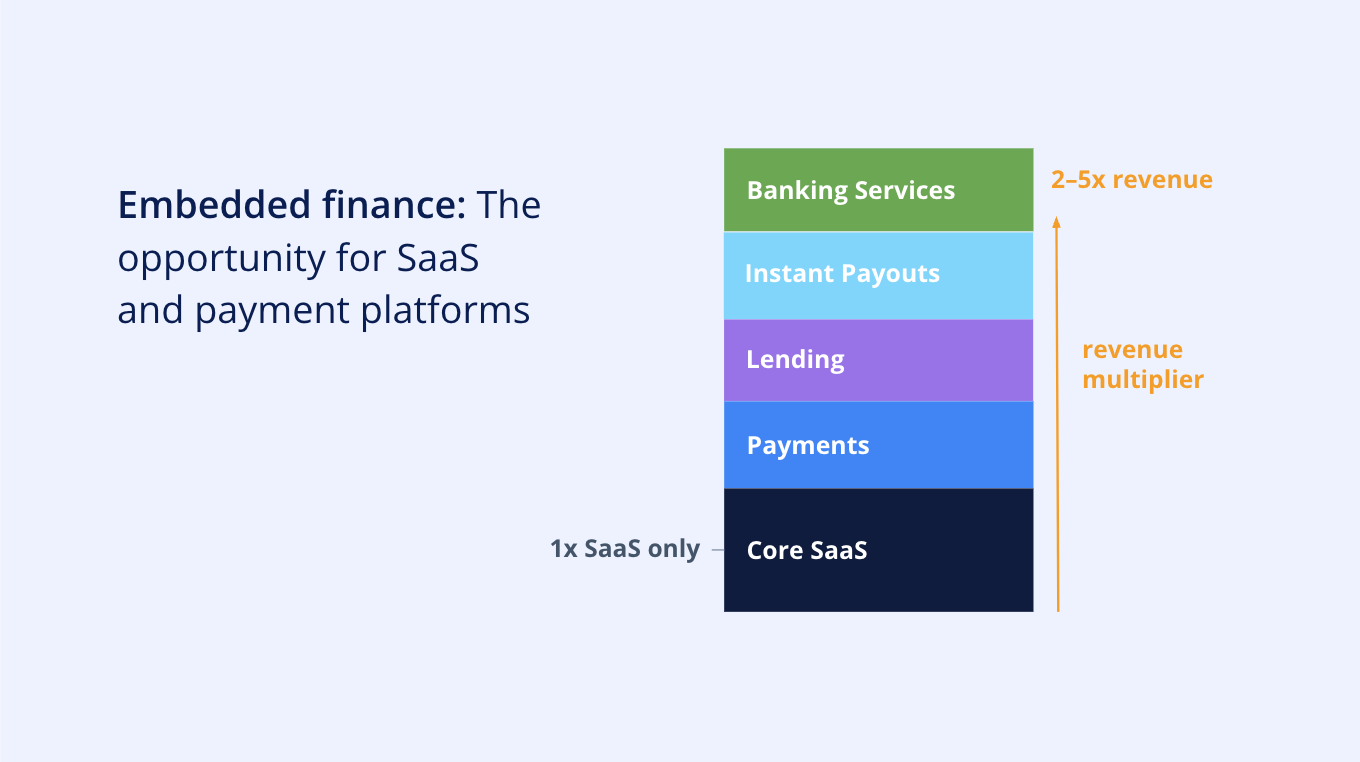
Embedded finance isn't a single product. It's a category with multiple products, each with its own maturity curve, economics, and operational requirements:
Payments — the entry point and most mature category. Initiated and processed inside the merchant's workflow.
Lending — where margin and retention lives. Transaction data from payments underwrites the loan. This is why the sequencing almost always goes: payments first, then lending.
Instant Payouts — the fastest-growing merchant need, and increasingly monetized as its own product rather than a payments feature. It carries distinct transaction economics from core payments processing.
Banking Services — business accounts, deposits, and card issuing that turn the platform into a merchant's financial home. Again, multiplying revenue and retention for providers.
Embedded finance starts with payments for most platforms — but payments alone is no longer enough. The opportunity lies in what comes next: lending, instant payouts, and banking services.
A practical test: who delivers the regulated product? If a payments company offers lending built by a partner (white-label), that's embedded finance. If they build the lending product themselves from scratch — including the license, the capital, the underwriting — they're operating as a multi-product fintech. The distinction shapes your build-vs-partner decision (more on that in Post 2).
The best embedded finance products don't feel like add-ons. The financial product and the core platform create value together that neither delivers alone — that's the standard worth building toward.
The numbers behind why this conversation is in boardrooms
The business case for embedded finance isn't theoretical anymore. The data is sharp:
2–5x ARPU lift when platforms layer financial products onto their software
+23% valuation premium for EF-enabled SaaS companies; +51% for multi-product platforms
50% lower churn — EF-enabled platforms run 111% NRR vs. 105% for software-only
45%+ of US merchant acquiring revenue will flow through software platforms by 2029
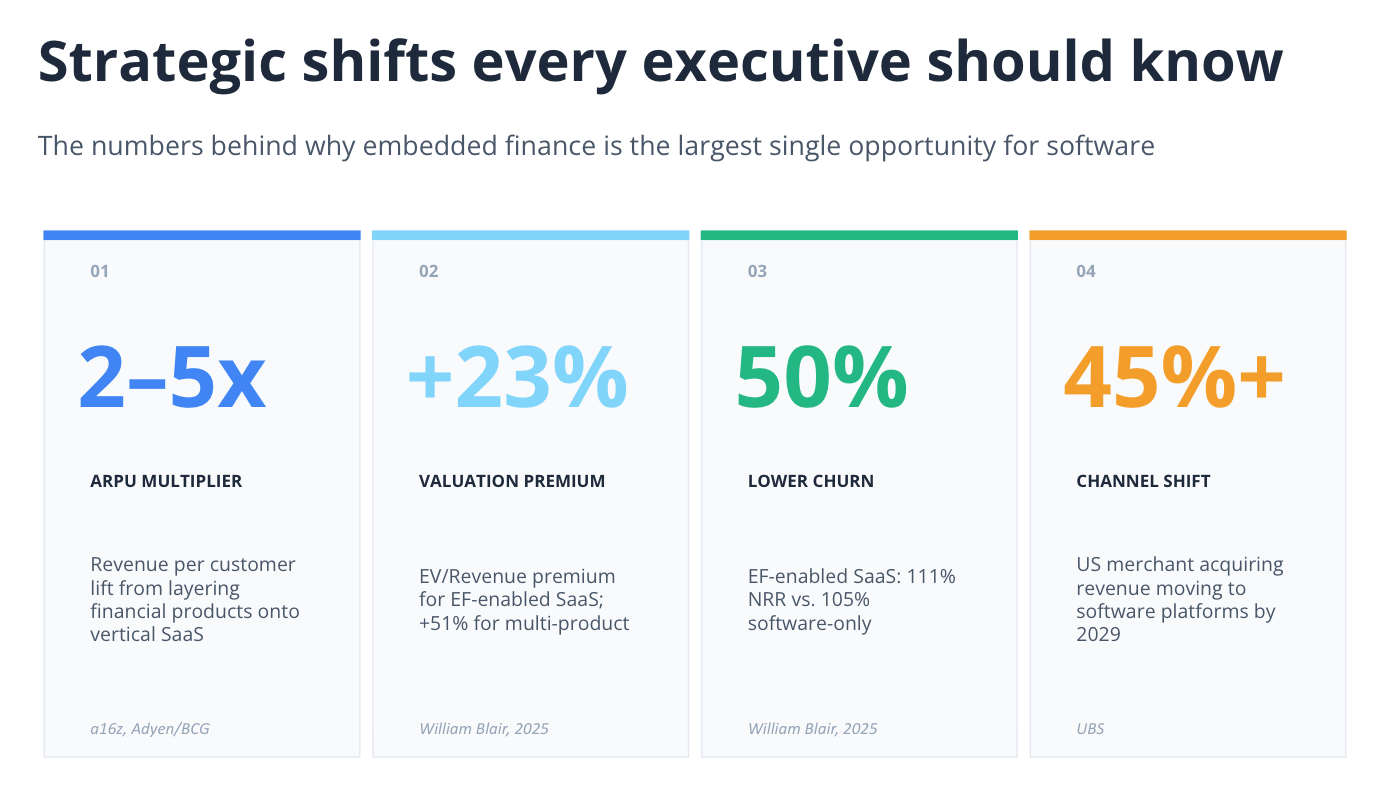
The valuation premium is the number most under appreciated by software executives. CEOs treat embedded finance as a revenue story. It's also a multiple-expansion story — the difference between a software multiple and a fintech multiple represents hundreds of millions in enterprise value for a platform thinking about a fundraise or exit.
Where most platforms stand today
Most vertical SaaS platforms and payments companies sit somewhere between Stage 2 and Stage 3 on the embedded finance maturity curve:
Stage 1 (Agnostic): No EF products, or payments embedded through Stripe but treated as a feature
Stage 2 (Payments embedded): Payments generating revenue; team starting to ask what comes next
Stage 3 (Multi-product): 1-3 EF products live, 30-50% of revenue from embedded finance
Stage 4 (Financial OS): EF as a dedicated P&L with its own GM and comp plan; fintech revenue starts to rival software revenue (Shopify, ServiceTitan, Intuit).
Stage 5 (Fintech-first): Toast, Block, BILL — Over 75% of revenue from financial services; software is the wedge, finance is the business.
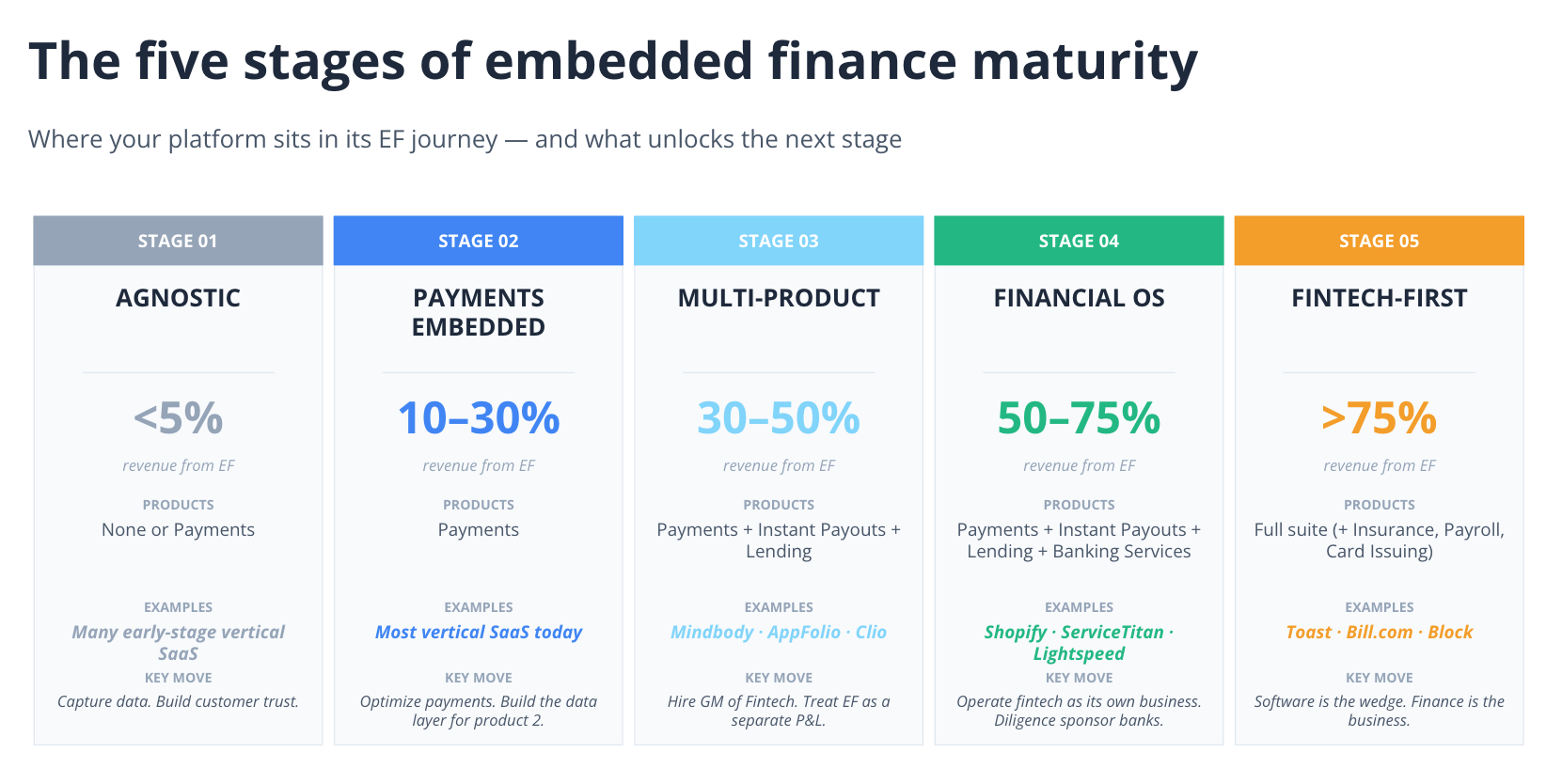
The next 24 months belong to Stage 2 and Stage 3 companies making the move. Payments is mature. Lending, instant payouts, and banking services still have lots of opportunity for growth. That's where the headroom is.
To learn more about how to launch new financial products, contact us.